


Research on Self-Pumping Biocomposite Dressings Based on Microporous Array Janus Membranes to Promote Wound Healing in Diabetes
Release time:
2020-12-03
Janus is a two-faced god in ancient Greek and Roman mythology, symbolizing the remembrance of the past and the anticipation of the future. In 1991, French scientist De Gennes first used the term Janus in his Nobel speech to represent asymmetric structures with different chemical compositions or properties. Due to the anisotropy of their morphology or chemical composition, Janus materials can integrate multiple properties or functions, mainly including Janus particles, Janus sheets, and Janus membranes, which hold significant potential research value in drug delivery, especially in the co-delivery of complex components of traditional Chinese medicine.
Janus is a two-faced god in ancient Greek and Roman mythology, symbolizing the remembrance of the past and the anticipation of the future.
In 1991, French scientist De Gennes first used Janus in his Nobel speech to represent asymmetric structures with different chemical compositions or properties. Janus materials, due to their anisotropy in morphology or chemical composition, can integrate multiple properties or functions, mainly including Janus particles, Janus sheets, and Janus membranes, which have significant potential research value in drug delivery, especially in the co-delivery of complex components of traditional Chinese medicine.
The high incidence, low cure rate, and high cost of diabetic ulcers are major issues that need to be addressed in the medical field. The main causes of their formation are local tissue ischemia, neuropathy, and infection. Wound edema can compress the local blood vessels and lymphatic system, increasing skin tension and local microvascular load, reducing blood supply to the flap, leading to local tissue ischemia, which is detrimental to wound healing.
Hydrophilic dressings are prone to sticking to the wound, often causing tearing during dressing changes; while hydrophobic dressings can avoid secondary damage to the wound, they are not conducive to drug delivery.
The microporous array Janus membrane, combined with a sodium polyacrylate absorbent layer (SAP) and a bioactive glass layer (BG), constructs a self-pumping composite dressing that can avoid secondary damage to the wound during dressing changes and accelerate diabetic wound healing by alleviating tissue edema and promoting angiogenesis.
Construction of the composite dressing
The research group first prepared hydrophobic polyurethane membranes (PU) and hydrophilic deacetylated cellulose acetate membranes (dCA) using electrospinning technology. Subsequently, the PU membrane was perforated to obtain a microporous array ArrayPU membrane, which was then combined with the dCA membrane to prepare a microporous array Janus membrane through hot pressing. As shown in the figure below, the composite dressing consists of a sodium polyacrylate superabsorbent layer (SAP), a microporous array Janus membrane, and a bioactive glass (BG) layer. The SAP layer can absorb wound exudate and expand, prompting the BG layer to release active ions. The microporous array Janus membrane allows the wound exudate to transfer from the wound to the composite dressing while enabling bioactive ions such as silicon ions and calcium ions to flow back to the wound through the microporous structure of the ArrayPU layer, stimulating angiogenesis and thus promoting wound healing.
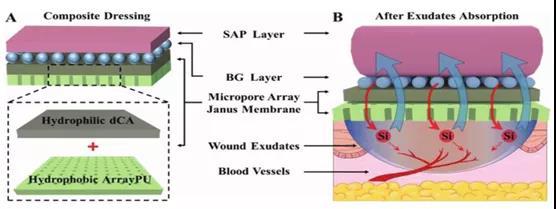 ▲ Cross-section of the composite dressing and its mechanism of action
Note: SAP refers to sodium polyacrylate superabsorbent particles, BG refers to bioactive glass particles, dCA refers to deacetylated cellulose acetate, and ArrayPU refers to polyurethane treated with a microporous array.
Research on the hydrophilic/hydrophobic properties of the microporous array Janus membrane
The Janus membrane layer is key to the self-pumping performance of the composite dressing. The authors used a standard Janus membrane (PU/dCA) as a control and studied the water delivery performance of the microporous array Janus membrane (ArrayPU/dCA) by measuring the water contact angle on both sides of the membrane. As shown in the figure below, there is no significant difference between the two Janus membranes on the dCA membrane side, mainly because dCA has strong hydrophilicity, allowing water to be freely transported; however, on the hydrophobic PU membrane side, the water contact angle of the ArrayPU/dCA membrane is significantly lower than that of the PU/dCA membrane, indicating that the microporous array structure of the Janus hydrophobic membrane is conducive to achieving controllable bidirectional transport of aqueous substances.
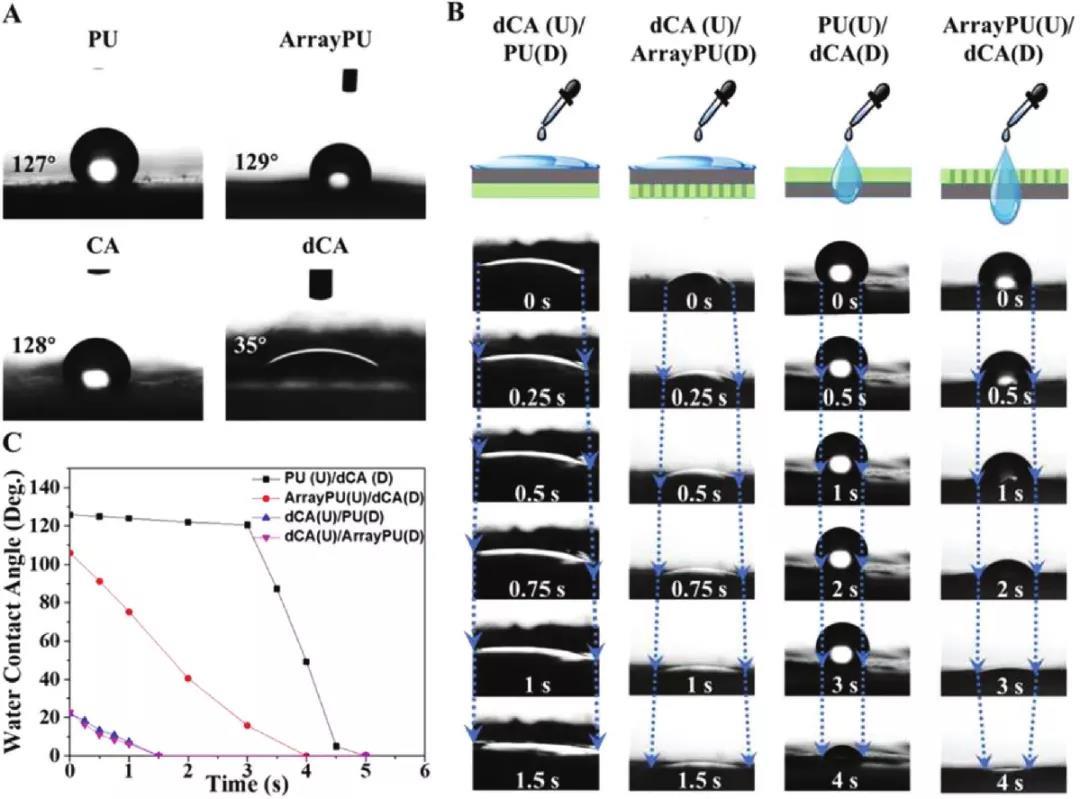 ▲ Changes in water contact angles over time on both sides of PU/dCA and ArrayPU/dCA electrospun Janus membranes
Research on the water absorption performance of the SAP layer, BG layer, and composite dressing
The authors used sodium polyacrylate superabsorbent particles (SAP) with an average particle size of 15.50 ?m to prepare superabsorbent layers with different SAP contents through a hot-pressing short fiber slurry method. The water absorption amounts and absorption rates are shown in figures A and B below. The study found that at 20SAP (i.e., SAP content of 2 g), the superabsorbent layer had the strongest water absorption capacity. The water absorption amount and absorption rate of the BG layer were far lower than those of the 20SAP superabsorbent layer, indicating that the BG layer does not significantly contribute to the water absorption performance of the composite dressing. Moreover, the water absorption amount and absorption rate of the composite dressing showed no significant difference from the SAP layer, indicating that the water absorption performance of the composite dressing is mainly determined by the SAP layer.
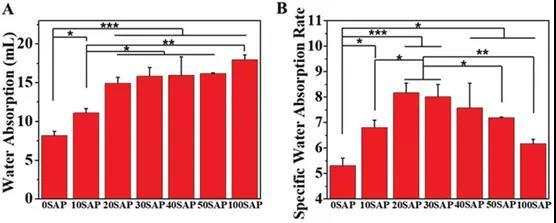 ▲ Water absorption amount (A) and water absorption ratio (B) of superabsorbent layers with different SAP contents soaked in deionized water for 24 hours (*p < 0.05, **p < 0.01, ***p < 0.001)
Detection of bidirectional water transport performance of the composite dressing
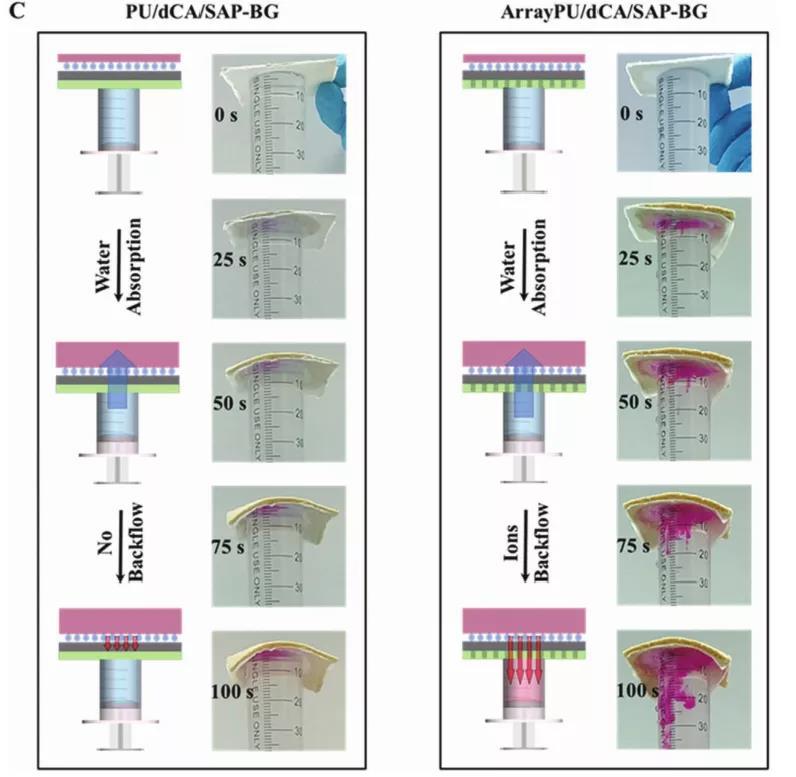
The authors designed an in vitro model to visually observe the water absorption and ion backflow performance of the composite dressing. The bottom of the model used a liquid pool containing phenolphthalein to simulate a wound with a large amount of exudate, while the top was covered with the composite dressing. As shown in the left image, both composite dressings can absorb liquid from the bottom liquid pool and expand. However, the composite dressing containing the microporous array Janus membrane (ArrayPU/dCA/SAP-BG) can also transport alkaline ions from the bioactive glass layer to the liquid pool, reacting with phenolphthalein to show a pink color; while the normal composite dressing (PU/dCA/SAP-BG) gradually shows pink at the bottom of the membrane due to the dissolution of bioactive glass particles, there is no liquid backflow phenomenon throughout the experiment, further indicating that the microporous array Janus membrane has controllable bidirectional transport functionality.
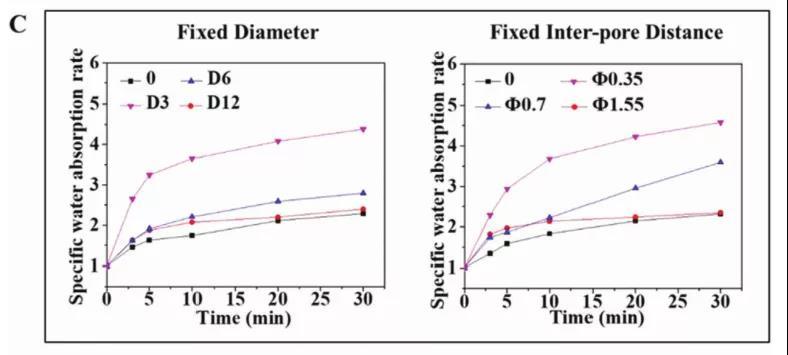
The authors also screened the changes in water absorption rates of composite dressings with different pore sizes and inter-pore distances, identifying that a pore size of 0.35 mm and an inter-pore distance of 3 mm provided the strongest water absorption capacity (as shown in the figure).
 Research on the in vivo repair of diabetic wounds using composite dressings
The authors used 3M Tegaderm dressings as a control and employed a mouse diabetic wound model to compare the effects of 0BG composite dressing and 20BG composite dressing on the in vivo repair of diabetic wounds. The study found that the healing effect of the 20BG group mice was significantly better than that of the 0BG and control groups. Pathological section results showed that the width of the newly formed epithelial tissue in the 20BG group mice was significantly lower than that in the 0BG group, further indicating that the microporous array Janus membrane can facilitate the backflow of bioactive ions, promoting wound repair. Angiogenesis can provide nutrients for wound repair and is an important indicator of wound healing effectiveness. Both visual inspection and immunohistochemical experiments indicated that the number of new blood vessels in the 20BG group mice significantly increased, suggesting that the composite dressing based on the microporous array Janus membrane can enhance wound repair by promoting angiogenesis.
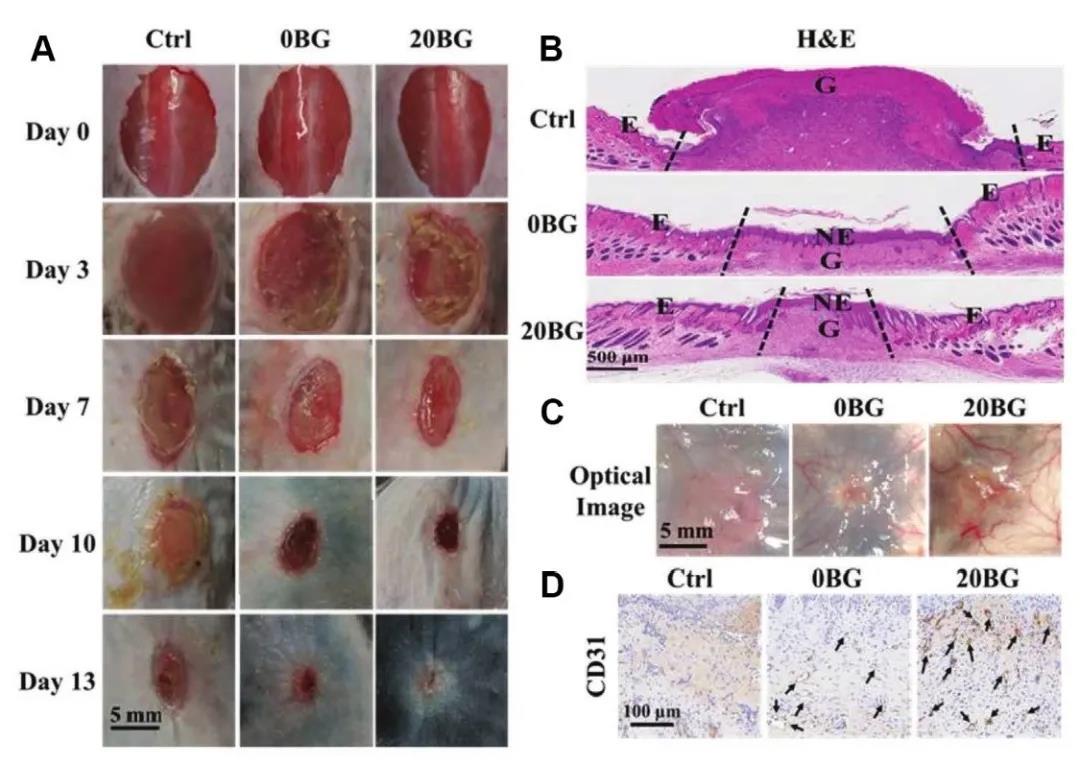 ▲ The effect of composite dressings on promoting the healing of diabetic wounds in vivo
Note: (A) Photos of the wound during medication; (B) H&E pathological sections of the wound 13 days after medication; (C) Photos of angiogenesis in the wound; (D) CD31 immunohistochemical staining of the wound.
Summary and Outlook:
The author constructed a self-pumping composite dressing based on a microporous array Janus membrane, using bioactive glass as the active layer, promoting wound repair through silicon and calcium ion reflux. However, the formation mechanism of wounds, especially chronic wounds, is very complex, and the effect of single treatments is very limited.
Traditional Chinese medicine can exert therapeutic effects while regulating the immune function of the body, achieving both internal and external treatment, and addressing both symptoms and root causes; it also has the characteristic of "combining medicine and auxiliary materials," where active substances are often polysaccharides and proteins, making them good membrane materials. Utilizing the characteristics of the microporous array Janus membrane to construct a self-pumping composite dressing suitable for the delivery of active ingredients from traditional Chinese medicine has significant research value and clinical significance.
Related Information
Beijing XinyiHuida Electromechanical
E-mail: xinyihuida@163.com
Mobile: +86-13911770565 Mr. Lin (General Manager)
Address: 415, 4th Floor, No.2 Jinguangnan Street, Jinguangnan Street, Xilu Street, Fangshan District, Beijing
Product Category







Copyright© Beijing XinyiHuida Electromechanical Equipment Co., Ltd