


Research Progress of Traditional Chinese Medicine Gel Patches and Their Application in Product Development
Release time:
2021-01-22
Transdermal therapeutic systems (TTS) refer to controlled-release formulations that deliver medication through the skin for local or systemic therapeutic effects. The prominent advantages of TTS include the ability to avoid the first-pass effect in the liver and the degradation of drugs in the gastrointestinal tract, thereby reducing gastrointestinal irritation; maintaining stable blood drug concentrations to avoid the peak and trough phenomenon associated with oral administration, which lowers toxic side effects; and providing long-lasting effects, extending dosing intervals, reducing the frequency of administration, and facilitating patient use.
Transdermal therapeutic system (TTS) refers to a controlled-release formulation that achieves local or systemic therapeutic effects through transdermal administration. The prominent advantages of TTS include avoiding the first-pass effect in the liver and degradation of drugs in the gastrointestinal tract, reducing gastrointestinal irritation; maintaining a steady-state blood drug concentration, avoiding the peak and trough phenomenon caused by oral administration, and reducing toxic side effects; providing long-lasting effects, extending the dosing interval, reducing the frequency of administration, and facilitating patient use.
Traditional Chinese medicine gel patches (originally gel preparations or plaster preparations) refer to patches made by mixing traditional Chinese medicine raw materials with suitable hydrophilic matrices and applying them to backing materials. As an important component of TTS, traditional Chinese medicine gel patches not only possess the advantages of TTS but also, compared to traditional black plasters and rubber plasters, have advantages such as good moisturizing properties, good compatibility with the skin, breathability, and the ability to be reapplied, which have increasingly attracted the attention of researchers.
Guided by the theory of traditional Chinese medicine, traditional Chinese medicine gel patches inherit the foundation of traditional Chinese medicine ointments while fully integrating modern gel preparation techniques and quality requirements, providing a new direction for theoretical research in external treatment of traditional Chinese medicine and secondary development of Chinese medicinal resources. This article reviews the current development status, matrix excipients, preparation processes, and quality control of traditional Chinese medicine gel patches.
1 Development Status of Traditional Chinese Medicine Gel Patches
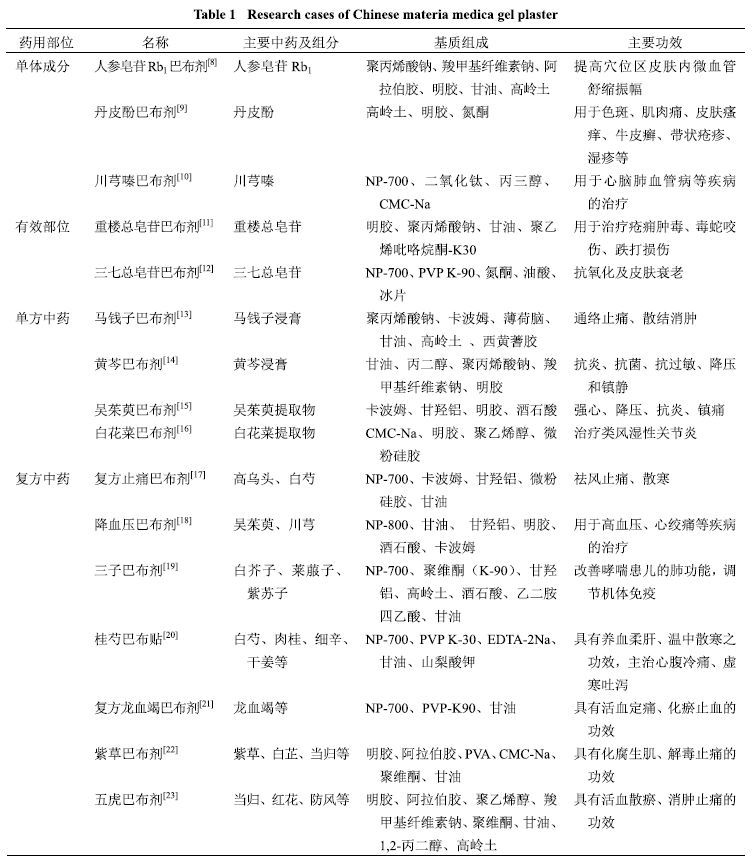
Since the 1980s, traditional Chinese medicine gel patches have developed rapidly, being first included in the 2000 edition of the Chinese Pharmacopoeia and named as plaster preparations, with corresponding quality specifications. The 2010 edition of the Chinese Pharmacopoeia renamed plaster preparations to gel preparations and made relevant regulations on the production and storage conditions of gel preparations, as well as specified corresponding inspection indicators, such as checking the content of the gel, its formability, adhesion, and microbial limits, providing a legal basis for quality control of gel preparations. The 2015 edition of the Chinese Pharmacopoeia redefined it as gel patches, categorizing it under patch preparations. The former CFDA has announced that there are currently 9 types of traditional Chinese medicine products on the market, including anti-inflammatory and analgesic plaster, wind-damp bone pain plaster, compound purple-bamboo pain relief plaster, bone friend plaster, toad venom analgesic gel, toad venom gel, joint pain plaster, pain relief plaster, and Shaolin rheumatism and trauma gel, mainly used externally for soft tissue injuries, rheumatism, arthritis, and other conditions. The number of patent applications and new drug research related to traditional Chinese medicine gel preparations is continuously increasing, involving drugs for various systemic diseases such as cardiovascular, skin, respiratory, and circulatory diseases. By reviewing research literature on traditional Chinese medicine gel preparations from the past five years in China National Knowledge Infrastructure and summarizing it, some research examples are shown in Table 1. While traditional Chinese medicine gel patches are rapidly developing, there are also many issues: first, the components of traditional Chinese medicine are complex and mostly compound, with a large dosage, limiting the drug loading capacity of the gel; unreasonable matrix ratios lead to unstable product quality, prone to peeling and leaking, and poor adherence to the skin; the quality evaluation system is not perfect, with low technical levels of quality evaluation and a lack of unified and standardized quality standards; production equipment and technology are relatively backward, greatly limiting the industrialization and large-scale development of traditional Chinese medicine gel patches.
2 Composition of the Matrix in Traditional Chinese Medicine Gel Patches
Traditional Chinese medicine gel patches consist of a backing layer, a gel layer, and a protective layer, where the gel layer is the key, serving as the drug reservoir and determining the quality of the gel patch. The matrix of the gel layer can be divided into non-crosslinked and crosslinked matrices, with crosslinked matrices becoming the focus of research. The composition of crosslinked matrices is complex, and the formulation design of the matrix plays a key role in the overall adhesion, flowability, transdermal absorption, and moisturizing properties of the gel.
2.1 Crosslinked Framework
The framework materials in the matrix generate viscosity, allowing the gel to adhere to the skin surface, while also supporting the internal molecules of the gel to form a network structure, providing sufficient cohesion, elasticity, and certain strength. Common hydrophilic gel frameworks include synthetic, semi-synthetic, and natural polymer materials. Synthetic and semi-synthetic polymer materials include sodium polyacrylate, polyvinylpyrrolidone, polyvinyl alcohol, carbomer, sodium carboxymethyl cellulose, methylcellulose, etc.; common natural polymer materials include gelatin, gum arabic, astragalus gum, white lily gum, alginates, agar, etc.
In the preparation of the matrix, polymers such as sodium polyacrylate, carbomer, and gelatin undergo crosslinking and curing reactions by adding crosslinking agents and crosslinking regulators, where high-valent metal ions chelate with the crosslinked framework, and the crosslinking regulators can adjust the reaction time and degree of crosslinking. The linear molecular chains of the polymers bond with each other to form a crosslinked network structure. Common crosslinking agents are mainly high-valent metal ions, with aluminum salts being the most commonly used, including aluminum glycinate, glyceryl aluminum, aluminum chloride, aluminum hydroxide, etc.; common crosslinking regulators include citric acid, tartaric acid, lactic acid, malic acid, and ethylenediaminetetraacetic acid (EDTA), etc.
2.2 Fillers
Fillers play an important role in the shaping of the gel, and they also affect the adhesion and cohesion of the gel, improving the excessive stickiness caused by the swelling of water-soluble polymer materials. Common fillers include kaolin, micro-powdered silica, soapstone, white clay, titanium dioxide, calcium carbonate, zinc oxide, and drug fine powders.
2.3 Moisturizers
Hydrophilic gel frameworks have a high water content, and the addition of moisturizers can slow down the loss of water from the matrix, promote skin hydration, and also affect the formability, adhesion, and drug release of the matrix. Common moisturizers include glycerin, propylene glycol, polyethylene glycol, and sorbitol, with a composite system of two moisturizers showing better moisturizing effects.
2.4 Permeation Enhancers
Due to the barrier limiting effect of the skin stratum corneum, the transdermal rate of most drugs is slow and the amount that penetrates is low. By adding an appropriate amount of transdermal absorption enhancers, the skin structure can be reversibly altered, reducing the resistance faced by drugs as they pass through the skin, thus achieving the goal of local treatment or systemic absorption. Absorption enhancers are divided into two main categories: natural and synthetic. Natural enhancers mainly include volatile oils from traditional Chinese medicine, such as terpenes and lactones, including menthol, borneol, eucalyptus oil, and other volatile extracts; synthetic enhancers mainly include lauryl nitroxide (azone), dimethyl sulfoxide (DMSO), propylene glycol, borneol, dimethylacetamide, organic acids and esters, phthalimides, etc. DMSO has been used less frequently due to its strong toxicity and skin irritation, while lauryl nitroxide is currently recognized as a better transdermal absorption enhancer.
Currently, a multi-component system is often used, employing two or more enhancers. This can reduce the amount of enhancers used while achieving better transdermal absorption effects through combined use. Lou Buqing et al. conducted in vitro transdermal experiments, using enhancement ratio (ER) as an indicator to investigate the promoting effect of nitroxide, oleic acid, and propylene glycol, either alone or in combination, on the transdermal penetration of berberine hydrochloride in a double yellow plaster. They determined that the ratio of nitroxide-propylene glycol-oleic acid should be 3:5:1, and the results indicated that using a ternary system can overcome the insufficiency of a single system and the adverse effects on the plaster.
3 Preparation Process
The appearance of traditional Chinese medicine gel patches should be uniform in color, free of bubbles and graininess, without any peeling, leakage, or skin residue. They should possess good adhesion, moisturizing properties, and excellent transdermal absorption effects. The preparation process of gel patches is closely related to the aforementioned properties, and in-depth exploration of the matrix process of traditional Chinese medicine gel patches, along with the formulation of a reasonable process route, has become a key focus of research.
3.1 Matrix Ratio Research
The research on the matrix of traditional Chinese medicine gel patches revolves around the ratios of crosslinked frameworks, moisturizers, fillers, and crosslinking agents. A reasonable experimental design method and evaluation indicators are used for comprehensive evaluation of the matrix, optimizing the matrix ratio scheme. Currently, methods such as orthogonal experimental design, uniform experimental design, or response surface optimization are commonly used to optimize the matrix formulation. Evaluation indicators include initial adhesion, holding power, peel strength, and overall sensory evaluation. Xue Caihong et al. used L9(34) orthogonal experimental design, focusing on appearance, peel strength, matrix residue, skin adhesion, and repeated peeling properties, to investigate the amounts of sodium polyacrylate-pressure-sensitive adhesive, sodium carboxymethyl cellulose-gelatin, aluminum hydroxide, and glycerin, ultimately determining the formulation ratio to be 0.5:1.0:0.4:0.1:0.3:3.0. The resulting gel patch has good shaping properties and no skin residue. Zhang Hongbing et al. used star point design-response surface optimization method, with initial adhesion and appearance (paste properties, residue, skin adherence) as comprehensive evaluation indicators, normalizing the experimental data and performing multiple linear and nonlinear regression analysis on each factor, ultimately determining the ratio of NP-700, Carbopol 940, aluminum hydroxide, micro-powdered silica gel, and glycerin to be 5.34:0.63:0.20:6.00:30.00, resulting in a compound analgesic patch with suitable matrix adhesion, no residue, and good paste properties. Li Zhiyong et al. used uniform design method U17(1716) to optimize the matrix formulation of cancer pain patches, with initial adhesion, peel strength, and overall appearance score as optimization indicators, resulting in the best matrix ratio of sodium polyacrylate-gelatin-kaolin-aluminum hydroxide-castor oil-glycerin-polyvinyl alcohol 6.46:6.00:4.10:0.08:0.10:56.00:0.05, producing a patch with a smooth appearance, suitable viscosity, and good extensibility.
3.2 Forming Process Research
3.2.1 Drug Factors Most traditional Chinese medicines are added to the matrix formulation in the form of extract pastes, which have complex and diverse components. For example, the acidity and alkalinity of the drugs can affect the pH of the matrix, thereby influencing the adhesion of the patches; the dissociation of the drugs also affects the forming process. When free ions are present in the extracts of traditional Chinese medicine, these ions can enter the network structure of the polymer, altering the time and degree of crosslinking and curing of the paste, ultimately affecting various properties of the paste. Therefore, it is necessary to investigate the chemical properties of traditional Chinese medicine extracts and reasonably add excipients to reduce the impact of drugs on the formulation process.
3.2.2 Paste Factors The influence of the paste on the formulation process mainly manifests in two aspects: first, the water content of the paste, which, as a hydrophilic gel framework, has a significant water content in gel patches, usually between 40% and 60%. High molecular polymer materials generate viscosity through water swelling and dissolution, but excessively high or low water content can have adverse effects. Second, the drug loading of the paste; if the drug content is too high, it can complicate the formulation process, while too low a drug amount may not achieve clinical efficacy. Li Lin et al. studied the effects of different drug loading amounts of luteolin patches on transdermal absorption, using microdialysis technology to investigate their in vivo transdermal enhancement. The results showed that with drug loading amounts of 1.5%, 1.0%, and 0.5%, the cumulative transdermal amounts of luteolin were 8.32, 6.53, and 6.38 μg/cm2, respectively, further determining the drug loading amount of the patches.
3.2.3 Process Factors In the preparation of the paste, the influence of the preparation process conditions on the molding is concentrated in: ① The order of material addition, the matrix composition involves cross-linked frameworks, fillers, cross-linking agents, and other auxiliary materials, including synthetic or semi-synthetic polymers, as well as various inorganic substances and other materials. The differences in their physical and chemical properties require a reasonable addition order; otherwise, it directly affects the molding and curing of the paste. Bai Chaitang et al. examined three addition methods for different materials and ultimately determined that the polymer gel phase should be fully mixed with the drug and moisturizing agent in the aqueous phase as the mixing phase, and then the aqueous phase containing the cross-linking agent should be slowly dripped into the mixing phase, resulting in a paste that is elastic and glossy. ② The degree of mixing and stirring, during the mixing and stirring process of various materials, the time and speed of stirring have a significant impact on the paste. If the time is too short, the materials will not be mixed evenly; if the time is too long or the speed is too fast, it will produce a large number of bubbles in the paste, and the molecular chains of the polymer matrix will break, reducing the viscosity of the paste. ③ The temperature of kneading and drying, if the kneading and temperature are too high, it will reduce the viscosity of the paste, and the most suitable kneading temperature should be selected based on the specific matrix composition. Liu Lin et al. conducted an orthogonal experimental design, using comprehensive scores such as adhesion and appearance as indicators, focusing on the effects of kneading temperature, kneading time, and stirring speed on the preparation process of β-asarone plaster, ultimately determining the optimal preparation process to be a drug loading of 8.7%, stirring speed of 500 r/min, kneading temperature of 45 °C, and kneading time of 15 min, resulting in a plaster with a glossy appearance and moderate viscosity.
3.3 Application of New Technologies in Molding Process
Due to the complexity of traditional Chinese medicine components, to further adapt to the formulation requirements of gel patches and solve practical problems in the preparation process, more and more new technologies and processes are being used in the preparation of traditional Chinese medicine gel patches.
3.3.1 Solid Dispersion Technology The application of solid dispersion technology in the preparation of traditional Chinese medicine gel patches can improve the dispersion of drugs, which is beneficial for drug dissolution and absorption, thereby increasing the transdermal penetration of the drug. Lin Yining et al. used carrier combination technology to prepare baicalin into solid dispersions, phospholipid complexes, and solid dispersions of phospholipid complexes, using a modified Franz diffusion device to measure the transdermal absorption characteristics of these three plasters. The transdermal rates of the solid dispersion of phospholipid complexes, solid dispersions, phospholipid complexes, and the prototype drug of baicalin were 135.26, 100.22, 76.10, and 49.31 μg/(cm2·h), respectively, indicating that the solid dispersion of phospholipid complexes had the highest transdermal rate, effectively improving the transdermal absorption of baicalin.
3.3.2 Microemulsion Technology Microemulsion technology prepares a colloidal dispersion system by emulsifying the aqueous and oily phases with emulsifiers, which is beneficial for fat-soluble drugs to better mix with hydrophilic matrices, while also improving skin permeability. Zhang Guangchang et al. prepared a water-in-oil microemulsion plaster of Wu Zhu Yu extract to improve the permeability of fat-soluble components in the extract, ensuring better mixing of the drug with the matrix. The microemulsion formulation was Wu Zhu Yu extract - isopropyl myristate - propylene glycol - polysorbate 80 - hydrogenated castor oil - water in a ratio of 0.3:0.6:3.6:3.6:3.6:18, and the in vitro 24-hour cumulative permeation amounts of Wu Zhu Yu alkaloids and Wu Zhu Yu secondary alkaloids in the water-in-oil microemulsion plaster were 1.86 and 1.40 times that of ordinary plasters.
3.3.3 Inclusion Technology The volatile oil components of traditional Chinese medicine play a pharmacological role and can promote the transdermal absorption of drugs to a certain extent, but the presence of a large amount of volatile oil can cause difficulties in the preparation of gel patches. The application of inclusion technology in the preparation of traditional Chinese medicine gel patches can improve the stability of volatile oils in the formulation. Chen Hongmei used β-cyclodextrin inclusion technology to encapsulate the volatile oil components in the cooling and activating plaster, which is beneficial for the dispersion of volatile components in the water-soluble matrix, improving the stability of the formulation.
3.3.4 Ultrafine Grinding Technology Some traditional Chinese medicines in gel patches are used in the form of raw drug powders. After cell-level grinding, smaller particle sizes and larger specific surface areas can be obtained, allowing for the rapid release of effective drug components. Additionally, using ultrafine powders for medication improves the compatibility of the drug with the matrix. Li Yuehui et al. used ultrafine grinding technology to grind cattail pollen to a particle size of 37 μm (D90) and 11 μm (D50), preparing an ultrafine plaster of Tumor Pain Relief. Using a Franz diffusion cell, they measured the transdermal rate of isoquercitrin-3-O-neohesperidoside and compared it with ordinary Tumor Pain Relief plasters. The transdermal rates of the two were 3.0382 and 2.7967 μg/(cm2·h), respectively, with cumulative permeation amounts and transdermal rates both superior to those of ordinary Tumor Pain Relief plasters, indicating that ultrafine grinding technology can effectively improve drug dissolution and transdermal absorption. Zhang Wei et al. compared the drug release rate of ferulic acid in ultrafine powdered Chuanxiong plaster and ordinary fine powdered plaster in isolated rabbit skin, with experimental results showing that the cumulative transdermal release rate of ferulic acid in the ultrafine powdered plaster reached 42.57% within 4 hours and 58.26% within 20 hours, nearly 15% higher than that of ordinary fine powdered plaster.
4 Quality Control Research
The 2015 edition of the Chinese Pharmacopoeia specifies conventional items for gel patches, including appearance, drug content, formulation properties, adhesion, and heat resistance. The complexity of traditional Chinese medicine components significantly affects the performance of the paste, particularly in terms of adhesion. At the same time, the issues of drug release and transdermal absorption of traditional Chinese medicine components, as well as the irritant effects of toxic traditional Chinese medicines on the skin, require in-depth discussion and research. Therefore, establishing objective, scientific, comprehensive, and unified quality standards, and improving quality specifications that reflect the formulation requirements of traditional Chinese medicine gel patches is of great significance.
4.1 Adhesion Research
The pharmacopoeia's quality evaluation of adhesion includes three aspects: the initial adhesion, holding power, and peel strength of the paste, without specifying the parameters of the instruments, backing materials, or quality standards. Many researchers have evaluated the performance of the paste through a combination of instrumental evaluation and sensory evaluation. However, conventional instrumental evaluations cannot reflect the intrinsic rheological parameters of the paste, and while sensory evaluations have certain practical significance, they also have issues such as weak objectivity and significant individual differences, which cannot comprehensively and accurately reflect the intrinsic quality of gel patches.
For the matrix of cross-linked hydrogel patches, determining its rheological parameters can objectively and truthfully reflect the internal cross-linking situation of the paste, providing a reference basis for the evaluation of the matrix's adhesion. Wang Jian et al. [50] measured the rheological properties of different filler matrix formulations using a rotational rheometer when screening filler formulations, including measuring complex modulus (G*), elastic modulus (G′), and viscous modulus (G″) rheological parameters. The results showed that with the increase of mass fraction of different fillers, both G′ and G″ increased, with micro-powdered silica having the greatest effect; when its mass fraction increased from 1% to 5%, G′ and G″ increased by 99% and 130%, respectively. The changes in G′ and G″ affected the viscoelasticity of the matrix. Gu Shengying et al. [51] established the relationship between the rheological parameters of the plaster and the viscosity of the matrix, concluding that the initial adhesion force of the plaster was negatively correlated with the phase angle δ (ω=0.1 rad/s) under low-frequency conditions, and the peeling strength was negatively correlated with the G′100/G′0.1 value. The cohesive force of the paste was negatively correlated with the creep compliance (Jc). When the δ0.1 value was between 24° and 26°, the G′100/G′0.1 value was between 5 and 7, and the Jc value was around 0.1, the viscosity of the paste was suitable. Wu Wei et al. [52] explained the impact of the glass transition temperature (Tg) on the cross-linking and curing of the matrix from the perspective of polymer thermodynamics, noting that phenomena such as overly hard or soft paste were closely related to the Tg of the polymer materials. Attention should always be paid to the relationship between the overall Tg of the paste and the Tg of various excipients, as well as the distribution index of relative molecular mass and production processes, providing new ideas for studying the performance and preparation process of the matrix.
4.2 Transdermal Absorption Study
The release of active substances from the matrix and transdermal absorption are key to the local or systemic therapeutic effects of drugs, and are also critical aspects of ensuring product quality. In in vitro transdermal experiments, the physicochemical properties of the drug, the type of receiving liquid, and the type of animal skin, as well as the choice of evaluation indicators, can all affect the results of the transdermal experiments.
When traditional Chinese medicine components are administered as monomers or as extracts, the drug release process and transdermal absorption behavior differ. Deng Yali et al. [53] compared the drug release and transdermal behavior of compound plasters composed of monomers of Qingteng alkaloid and Lei Gong Teng alkaloid with their extract pastes. By measuring the in vitro release rate, it was shown that the in vitro release of Qingteng alkaloid and Lei Gong Teng alkaloid conformed to the Higuchi equation. The drug release rate (J) was basically the same for both monomer and extract administration in the same matrix; using the Franz diffusion cell method to measure in vitro transdermal absorption, each parameter was subjected to linear regression according to zero-order, first-order, and Higuchi kinetic equations, fitting the zero-order kinetic process. The transdermal rate of Qingteng alkaloid and Lei Gong Teng alkaloid administered as monomers was slightly higher than that of the extract.
The formulation of traditional Chinese medicine gel patches is often large and complex, with many component indicators. Choosing appropriate in vitro transdermal evaluation indicators is of great significance for quality control. Wu Xiaoru et al. [54] used a vertical Franz diffusion cell to measure the total alkaloids, atropine, and scopolamine in the pain-relieving plaster using acidic dye colorimetry and HPLC methods, determining the cumulative transdermal amount (Q). They regressed Q against time (t), and the results showed that both the total alkaloids and the indicators of atropine and scopolamine conformed to the zero-order kinetic process, both reflecting the transdermal absorption process of the patch well.
In in vitro transdermal experiments, the type of receiving liquid (penetration medium) and the choice of ex vivo animal skin can have different impacts on the experimental results. Sun Yuan et al. [55] used a modified Franz diffusion cell method, using 65% ethanol solution, physiological saline solution, 2% sodium dodecyl sulfate solution, 2% polysorbate 80 solution, and 30% ethanol solution as receiving solutions to investigate the ex vivo skin of Kunming female mice, male mice, and SD rats, to determine the penetration medium and skin type for the transdermal experiment of the pain-relieving plaster. Thin-layer chromatography qualitatively indicated that using a 30% ethanol solution as the receiving liquid and male mouse skin yielded the best transdermal response.
4.3 Skin Irritation Study
The application site of the gel patch is on the skin, and the irritation and toxicity caused by the drug after application need further verification and control. Evaluating the safety of toxic drugs and the particularities of pediatric medication is of significant guiding importance for the quality control of traditional Chinese medicine gel patches and the safety of clinical medication. Feng Wei et al. [56] investigated the skin irritation of the toxic drug Strychnos nux-vomica in the plaster, conducting skin irritation experiments with single and multiple doses using New Zealand white rabbits as models. The experimental results showed that single dosing did not cause irritation, erythema, edema, or other irritation phenomena on either intact or damaged skin, while multiple doses on damaged skin resulted in slight erythema, suggesting it should be avoided on damaged skin. Using guinea pigs as models to observe skin sensitization, the results indicated that the Strychnos nux-vomica plaster did not produce allergic reactions. Wang Jingxia et al. [57] verified through skin irritation experiments on New Zealand rabbits with multiple doses that the pediatric diarrhea plaster had no irritation on intact skin but had mild irritation on damaged skin, providing a reference for the clinical safe application of the pediatric diarrhea plaster.
5 Outlook
Compared with traditional black plasters and rubber plasters, traditional Chinese medicine gel patches have significant advantages in dosage form, with hydrophilic gel skeleton materials being more compatible with the skin, a large drug loading capacity, and the ability to be reapplied. With the development of modern pharmaceutical industry and the widespread application and continuous improvement of polymer materials, the preparation technology of traditional Chinese medicine gel patches is also continuously improving and developing. Techniques such as supercritical extraction, encapsulation technology, solid dispersion, and microemulsion technology are gradually being used to address issues such as drug loading capacity, stability, and transdermal absorption in traditional Chinese medicine gel preparations. At the same time, new quality control technologies are also being continuously applied to the quality evaluation of traditional Chinese medicine gel patches, such as near-infrared chemical imaging technology for evaluating the uniformity of the paste [58]; 60Co-γ radiation sterilization for sterilizing heat-sensitive substances in gel patches [59]; and microdialysis in transdermal absorption studies [60]. These new technological methods provide technical support for ensuring the quality and safety of traditional Chinese medicine gel patches. With the rapid development of transdermal drug delivery systems and the secondary development of traditional Chinese medicine varieties, traditional Chinese medicine gel patches are bound to encounter new development opportunities and achieve new technological breakthroughs and advancements.
Related Information
Beijing XinyiHuida Electromechanical
E-mail: xinyihuida@163.com
Mobile: +86-13911770565 Mr. Lin (General Manager)
Address: 415, 4th Floor, No.2 Jinguangnan Street, Jinguangnan Street, Xilu Street, Fangshan District, Beijing
Product Category







Copyright© Beijing XinyiHuida Electromechanical Equipment Co., Ltd